At The ReCollective, we’re committed to providing accessible, convenient, and impactful composting solutions to help our community significantly reduce organic waste. This initiative builds on our existing hard-to-recycle programs. Since we launched our community composting drop-off site initiative in December 2023, it has grown to 140 members who have collectively diverted more than 20,000 pounds of organics from the landfill.
We offer two flexible composting drop-off models tailored to diverse community needs:
Community Compost Neighborhood Drop-Off Sites
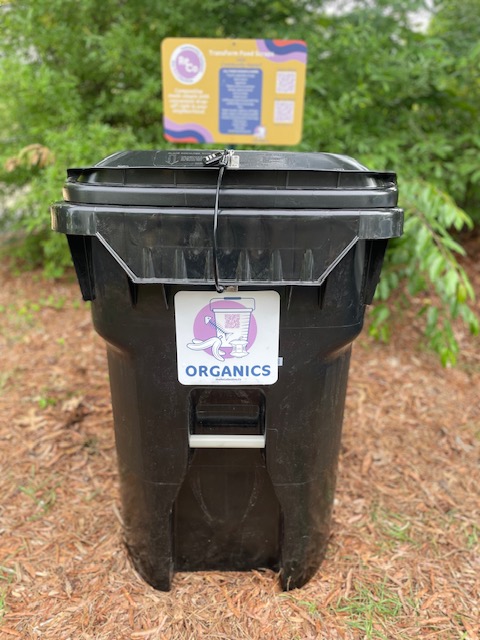
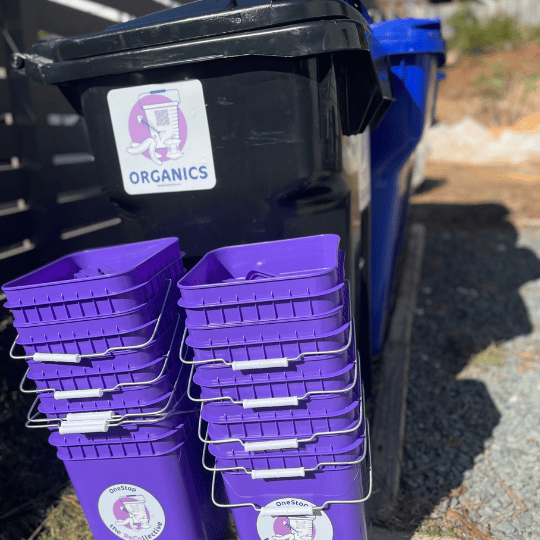
Our Neighborhood Drop-Off Sites provide convenient and secure composting solutions right within local communities. Members receive a 4-gallon Purple Bin for collecting food scraps, which they can empty at nearby designated carts. The ReCollective now operates seven neighborhood drop-off sites—five located within private HOAs, and two publicly accessible locations at Christ the King Lutheran Church and Lochmere Pavilion. More will be added in the coming weeks.
Key features:
- Affordable Pricing: $3.15 per week
- Personalized Impact Dashboard: Track and share your community’s environmental achievements on your personalized public dashboard
- Optional Add-On: Discounted doorstep pickup for hard-to-recycle materials such as plastic bags, textiles, and batteries
- Flexible Setup: Members may use the provided Purple Bin or their own containers. Liners are optional—paper bags or reused grocery bags are suitable; however, bioplastic bags are discouraged due to composting limitations.
- Secure Access: Drop-off bins are secured to prevent contamination. Members receive personalized access codes.
- Service Frequency: Compost pickups occur weekly with 10+ neighborhood participants or biweekly with 5–9 participants.
This solution is perfect for residents preferring local convenience, avoiding distant municipal drop-off sites, or lacking community composting infrastructure.
“Organizing my neighborhood has been incredibly easy. All I’ve done is send an email to see who was interested. I then sent a link for sign-up to interested neighbors. I distributed purple (home) bins by leaving them on my porch for neighbors to pick up. That’s it! The neighborhood cart fits nicely in my drive. I feel good knowing there are six more people composting and diverting food waste from the landfill. Added bonus: I see some of my neighbors more frequently when they stroll by to drop off their compost in my driveway bin.”
— ReCollective Community Compost Member
Durham Farmers’ Market Bin Swap
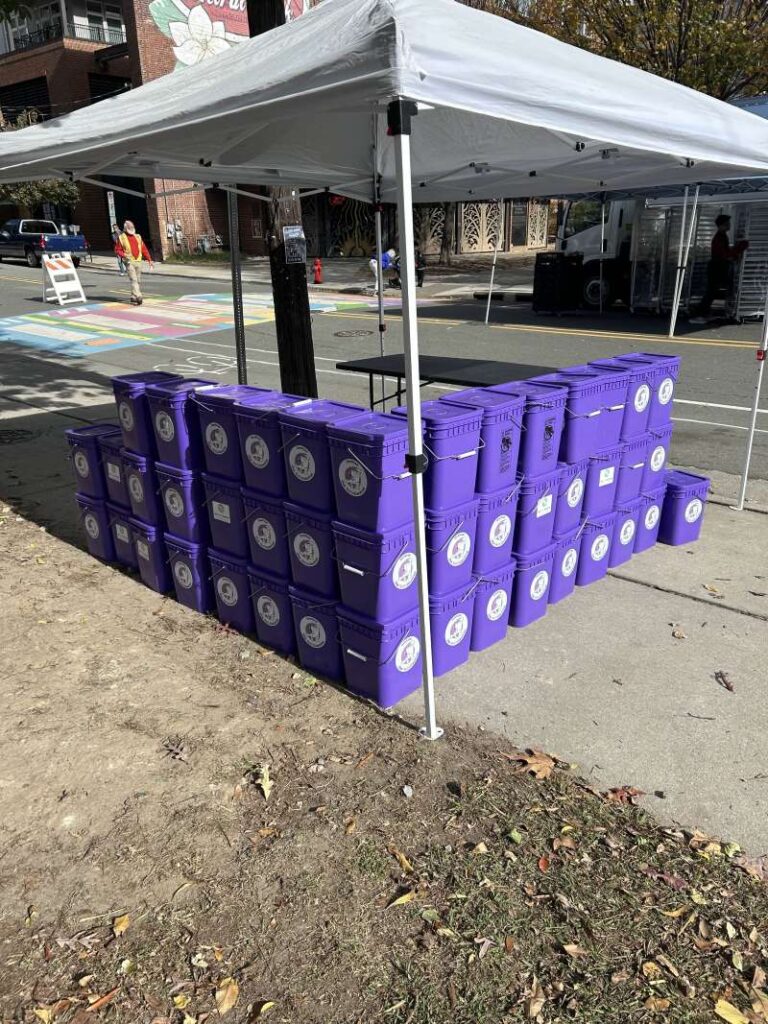
Our Purple Bin Swap program at the Durham Farmers’ Market offers an engaging, community-centered composting experience. Each Saturday at the market, members exchange filled 4-gallon Purple Bins of food scraps for clean ones.
Key Features:
- Biweekly Drop-Off: $12/month
- Weekly Drop-Off: $20/month
- Accessible Location: Ideal for frequent market visitors or downtown Durham residents
- Community Engagement: Opportunity to connect with fellow composters and engage in sustainability education at The ReCollective table
This program appeals to residents seeking a convenient, social, and regular composting practice tied to a popular community Farmers’ Market.
To ensure accessibility, The ReCollective offers need-based memberships, supported through community grants. Approximately 25% of current participants receive composting services at no cost.
Accepted Materials for Both Programs:
Both models accept a wide array of compostable items, including all food waste (cooked or raw), dairy products, meats, bones, seafood, bread, pasta, coffee grounds, paper goods, and cotton fabrics. Collected materials are transformed into nutrient-rich compost by Brooks Contractor, a leading commercial composter in our region.
Community composting is made possible through our partnership with Toward Zero Waste, a local sustainability leader dedicated to community education, waste reduction advocacy, and the advancement of circular economy practices. Together, we are strengthening Triangle areas infrastructure for organics recycling.
Why Community Composting Matters
Community composting goes beyond waste reduction—it delivers substantial environmental, economic, and social benefits:
- Reduces Waste & Emissions: Food comprises 24% of landfill waste in the U.S., producing methane—a greenhouse gas 84 times more potent than CO₂ over a 20-year span. Composting substantially reduces landfill waste and methane emissions, mitigating climate change and local air pollution.
- Enhances Soil Health: Compost revitalizes soil by restoring essential nutrients, improving water retention, and reducing erosion. Healthy soils boost local agriculture, green spaces, and carbon sequestration, contributing to enduring environmental resilience.
- Strengthens Community Resilience: Community composting promotes environmental education, supports local gardening and food access, and fosters meaningful neighborhood connections. It empowers hands-on environmental stewardship, builds awareness, and strengthens local resilience by reducing reliance on centralized waste management.
- Empowers Community Action: Composting provides an accessible means for residents to actively combat climate change and visibly contribute to sustainability, inspiring broader community engagement and action.
“Community Compost can be the tipping point for families interested in exploring composting. It’s easier than backyard composting, cheaper than private door-to-door service, and comes with built-in support from your neighbors and community! I would encourage anyone, and any community, to give it a try. You’ll get hooked.”
— Megan Holler, The ReCollective Community Compost Director
The Problem with Landfills
Understanding the significance of composting begins with recognizing the challenges posed by landfills. In landfills, these organics decompose anaerobically (without oxygen), releasing methane, which accelerates climate change. Landfills represent the third-largest source of methane emissions in the U.S.
Additionally, landfills are expensive to operate and have finite capacity. Many communities face steep costs associated with building new landfills or transporting waste to distant sites. Organic waste significantly exacerbates these issues despite being a resource that could otherwise enhance local soil health. By composting, we dramatically decrease landfill usage, preserve space, reduce greenhouse gases, and transform waste into valuable resources.
Looking for the Convenience of Home Pickup?
If you prefer the ease of doorstep composting service, The ReCollective offers the OneStop program, combining composting and hard-to-recycle material collection into a single, convenient doorstep pickup. This service is available in parts of Durham, Raleigh, Cary, Morrisville, and Chapel Hill.
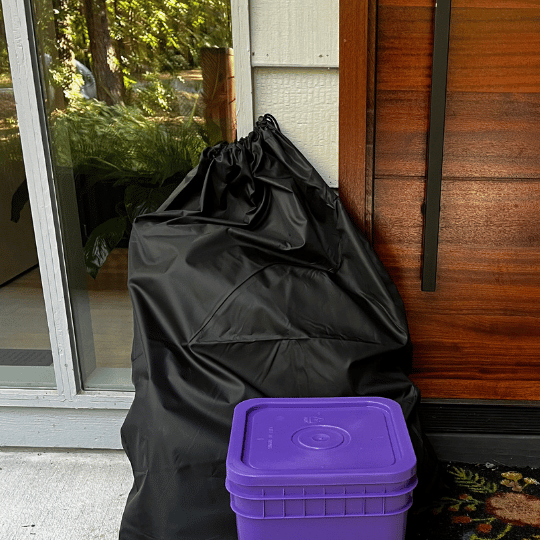
- OneStop Collection: Receive a 4-gallon Purple Bin for food scraps and reusable canvas bags for hard-to-recycle items like plastic film, textiles, batteries, and more.
- Flexible Scheduling: Choose between weekly or twice-monthly pickups for food scraps. Hard-to-recycle items are collected monthly, with the flexibility to select your preferred pickup week.
- Reward Options: Twice a year, opt to receive either a bucket of nutrient-rich compost for your garden or a free specialty recycling service as a thank-you for diverting waste from landfills.
- Affordable Pricing: Add food scrap composting to your hard-to-recycle plan starting at just $21/month.
Why Does a Hard-to-Recycle Service Also Do Composting?
At its core, The ReCollective is a hard-to-recycle service—but composting was a natural extension of our mission. Here’s why:
- The cost of traditional doorstep composting services can be a barrier for many households. We wanted to offer a more affordable, community-powered alternative.
- Municipal drop-off sites provide access but aren’t always convenient or close by, especially for families with busy schedules or limited transportation.
- The ReCollective is just two and a half years old and built to be nimble. We specialize in handling a wide range of materials—and organics are no exception. By leveraging the same infrastructure, vehicles, and team that power our hard-to-recycle pickups, we’re able to operate a more financially sustainable and efficient service that reduces waste across multiple streams.
For us, composting is not a separate service—it’s part of a bigger picture: helping communities manage their waste responsibly, affordably, and conveniently.
Learn more about Community Composting and OneStop!